
Hi readers!
RZN: Radio New Zealand, which is New Zealand’s independent, government-funded public service broadcaster, offering news, current affairs, arts, and entertainment across radio and digital platforms. RZN in the section of “World environment” published (on February 6th, 2024), an article titled “Sea sponge” temperature records point to underestimation of global warming”
A study on marine sponges has found that global temperature may already have exceeded 1.5 degrees. The research done in the University of Western Australia by Professor Malcolm McCulloch and his team which is based on 300 years of ocean temperature records preserved in ancient sea sponges showed that global warming had been underestimated by 0.5degrees because the records in the early industrial era were poor and limited by shipping routes, therefore, contrary to the IPCC (Intergovernmental Panel on Climate Change) estimate of average global temperatures (increased by 1.2 also shown in figure. 2 below), temperatures were in fact already 1.7 degrees above pre-industrial levels, says the McCulloch findings.
It is because of this finding:
“The clock of climate change has been forward by about a decade because things that were expected to happen 10 years from now are actually happening now.”
The research raises the question of whether average temperatures has already exceeded the Paris Agreement, (keeping warming to below 2 degrees) or will it exceed soon? McCulloch is of the view that climate change action needs to shift their focus from maximum global warming threshold to reducing emissions.
Dear readers! I have already shown the way to reduce emission in my earlier blog titled “From climate change to climate cleansing, what is the role of agricultural activities”?
Pl. visit the following website.
that was published on November 26th, 2025, where I showed through calculations, how much carbon emission can be reduced by cultivating just 1.7 Mt of cotton, and if we made similar calculations on all the crops being cultivating around the globe, imagine how much carbon emission can be reduced. In other words, Professor McCulloch is saying that instead of saying “no more above 2 degrees”, say “reduced emission”.
He further said that our study suggested the urgency of reducing emissions to half by early2030 and no later than 2040. I would suggest that it can be achieved earlier than 2030 if agricultural activities can be doubled or tripled which is not only possible but desired too.
Now just look at the following figures
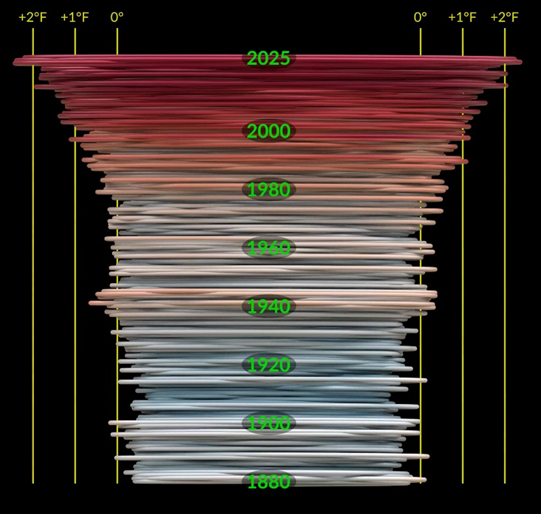
Figure 1.
The NASA climate spiral visualization with labels in English and Fahrenheit.
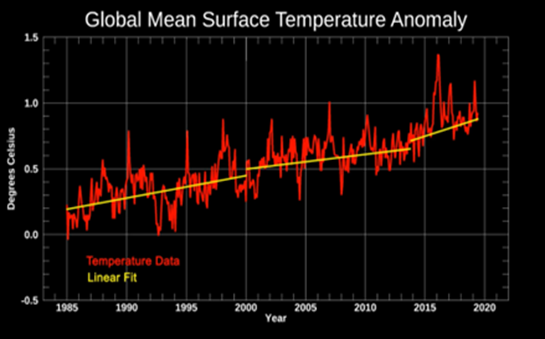
Figure 2.
Figure 1. shows that surface temperature has exceeded +2-degree Fahrenheit (-16.7 degree C) from the preindustrial era up to 2025 whereas figure 2. (https://berkeleyearth.org/global-temperature-report-for-2024/) showed that up to 2019, temperature increased by 1.2 degree C (approximately 54 oF) from preindustrial era. Figure 1 shows temperature in Fahrenheit while in figure 2, it is in degree Celsius: converting the two in same unit of temperatures confuse many readers who don’t understand what actually is happening with global surface temperatures? Why can’t both be recorded or mentioned either in Fahrenheit or in Celsius?
The pre-industrial global average surface temperature (1850-1900) was roughly 13.7 to 13.9°C (Av. 13.8 oC).
In 2024, temperature reached to about 1.4 to 1.5°C (av. 1.45) above that of baseline (making the total 15.25 0C), which made 2024: the warmest year (1.45oC increase from the pre-industrial era and indicated a significant manmade global warming trend.
The average global surface air temperature for 2025 is expected to be around 1.48oC (0.3oC more from the 2024 temperature) above the preindustrial era i.e. 15.28. This indicates that the global temperature is already significantly higher than the average from 1850-1900 (13.8oC) with 1.45 degrees increase in January 2025, (making the total 15.25) from base line till 2025.
All these calculations showed we have not yet but approaching 2 degrees increase from the baseline.
In 2024, the WMO: World Meteorological Organization estimated that the average global temperature was between 1.34°C and 1.41°C (Av. 1.375) higher than pre-industrial levels (1850-1900). The WMO now projects the 20-year average warming for 2015–2034 to reach around 1.44°C above pre-industrial levels whereas it has already increased by 1.45 oC in 2025. Such anomalies made people confused to the extent that even the people of the stature of American President don’t believer in climate change.
Dear readers! the impact of a 2 degree rise in global surface temperature would result in:
- Exposure of 27% of the population to severe heatwaves at least once every five years.
- 17% decrease in water availability in the Mediterranean region,
- Sea level rise projected to be ~0.1 meters higher by 2100 than at 1.5°C,
- Less than 1% of coral reefs will be left,
- 13% of land area projected to witness biome shifts,
- species loss doubles/triples compared to 1.5°C, and
- risks of multiple simultaneous maize production failures will increase from 6% to 54%.
Dear readers! I leave it to you to decide which one of the above factors you think are already in place thinking that 2 degree rise in temperature has taken place? See you again, take care, bye.